Stephan Dreyer, Managing Director at Association of National Numbering Agencies (ANNA), a sponsor at the 26…
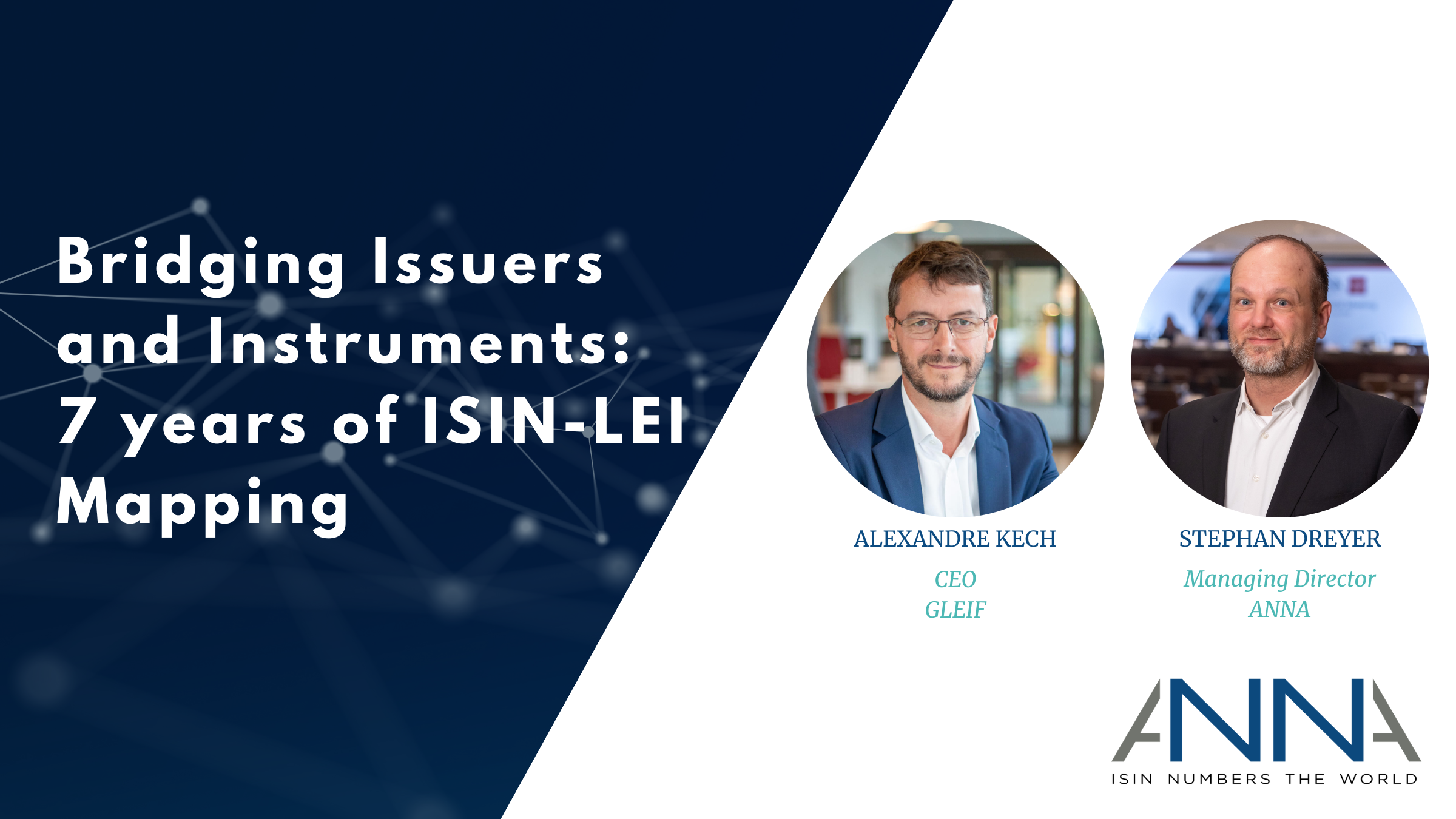
Bridging Issuers and Instruments: 7 years of ISIN-LEI Mapping
The ISIN-to-LEI mapping initiative went live on April 4, 2019, as a joint collaboration between the Association of National Numbering Agencies (ANNA) and the Global Legal Entity Identifier Foundation (GLEIF). This was a landmark moment for standardisation, connecting the International Securities Identification Number (ISIN) of a financial instrument directly to the Legal Entity Identifier (LEI) of the company that issued it.
ISIN-LEI mapping is the process of linking a company’s LEI to the ISINs of the securities it has issued. This helps users connect an entity with its financial instruments, improving transparency, data quality, and risk analysis. In simple terms, it answers the questions of which legal entity issued which security and the mapping is used by market participants, regulators, and data providers to cross-reference entity data with instrument data more efficiently.
7 years on and the initiative has proven to be a resounding success for global financial transparency. What began with 11 National Numbering Agencies (NNAs) providing 3.2 million mapping pairs quickly expanded. Today, the number of mappings now encompasses 8.593 million ISINs and 95,725 unique LEIs, with 31 NNAs spanning 65 jurisdictions now participating to cover major markets across Europe, Asia, the Americas and offshore centres.
In a Q&A below, Alexandre Kech, CEO of GLEIF, and Stephan Dreyer, MD of ANNA, reflect on the origins of the ISIN-LEI initiative, its continued importance, and future of this vital code connection between securities and their issuers.
Q1: Why was the ISIN-LEI mapping service created?
Stephan Dreyer, MD of ANNA: “Connection of the two complementary ISO standards; the ISIN (ISO 6166) and the LEI (ISO 17442) was established to enhance market transparency and support risk and exposure management. It solved siloed data issues post-financial crisis, enabling firms to aggregate exposures across issuers and related entities by directly linking an issuing entity to its financial instrument.
At its core the initiative brought together trusted and verified ISO standards, as the Global LEI registry offered by GLEIF is the only global source of open, standardised legal entity reference data, and the ANNA Service Bureau is the only global, centralised platform for directly sourced ISIN aggregation”.
Alexandre Kech, CEO of GLEIF: “Because firms could not reliably connect financial instruments to their issuers at scale, the mapping service addressed this gap by creating a direct, authoritative link between ISINs and LEIs, so that exposures can be traced consistently to the underlying legal entity. By relying only on data from official sources, it reduces reconciliation effort, removes ambiguity, and gives market participants a single, trusted reference point for issuer identification across systems and jurisdictions.”
Q2: Why was this linkage so important at the time of its launch, and why does it remain crucial today?
Stephan Dreyer, MD of ANNA: “At its launch, the ISIN-LEI mapping was key in helping the industry meet stringent new regulatory requirements in Europe, such as the Prospectus Directive, the Central Securities Depositories Regulation (CSDR), MiFID II, and the Securities Financing Transactions Regulation (SFTR). These required clear identification of issuers to monitor the risks associated with the securities financing market.
Fast forward to the present and ISIN-LEI mapping remains as crucial as it was at inception as these and other regulations are continuously evolving. With millions of mappings now available, the ISIN-LEI connection is still central to ensuring data quality, regulatory adherence, fraud prevention and the reduction of manual reconciliation costs. Whether it’s compliance, risk management, operational efficiency or new use cases, ISIN-LEI mapping endures in supporting financial industry workflows today.”
Alexandre Kech, CEO of GLEIF: “Initially, the linkage mattered because regulators and market participants needed a reliable way to anchor financial instruments to the correct issuer in a consistent manner. That need has not gone away; it has expanded. Today, the same connection is essential not only for financial risk and compliance, but also to attach new types of data, such as ESG metrics, to the right entity behind each security. Without that anchor, these datasets remain fragmented and difficult to use at scale. The ISIN-LEI mapping provides that continuity, enabling both regulatory and market use cases to evolve on a common, trusted foundation.”
Q3: What have been the most significant benefits for the financial industry?
Stephan Dreyer, MD of ANNA: “The primary benefits of ISIN-LEI mapping centre around data quality and process optimisation. The connection means that firms no longer need to conduct complex mapping work themselves; critically they are able to attain a more holistic view across their entire organisation, including its subsidiaries, rather than this being achieved on a piecemeal basis. Organisations gain benefit from leveraging reliable, open-source relationship files at no cost, which significantly reduces their operational burdens and lowers data management costs.”
Alexandre Kech, CEO of GLEIF: The most significant benefit is that firms can finally see risk and relationships consistently across instruments and counterparties. By linking securities to verified legal entities, institutions can identify who they are really exposed to, including across complex group structures, rather than relying on fragmented identifiers. This directly strengthens risk oversight, improves AML and KYC processes, and enables faster, more reliable decision-making. In practice, it moves the industry from fragmented views of data to a coherent, entity-based understanding of the financial system – effectively establishing a shared data infrastructure that different market participants can rely on.”
Q4: Looking ahead, what specific areas will standards mapping help with in the future?
Stephan Dreyer, MD of ANNA: “As financial markets evolve, mapping is helping to bring vital standardisation into the ecosystem. For example, further integration of the new XT ISINs for crypto assets which are now connected Digital Token Identifiers (DTIs), to the LEI can further enhance transparency and strengthen compliance in decentralised finance.
Transparency in digital assets will especially support market confidence and this is why we are focussed on working toward tri party ISIN-LEI and DTI mapping to underpin the essential standardisation that integrates crypto and tokenised assets into traditional infrastructure. XT ISIN + LEI linkage will enable firms to track which legal entity issued a specific crypto/tokenised security, mirroring equity/debt workflows for better risk aggregation and regulatory reporting (e.g., MiCA, EMIR). It will also create a unified identification framework for hybrid markets, reducing reconciliation breaks and enabling institutional adoption of new asset classes.”
Alexandre Kech, CEO of GLEIF:
“Looking ahead, the priority is to make the ISIN–LEI linkage systematic rather than optional. Embedding the LEI directly into ISIN reference data, where available, removes remaining gaps and ensures that every instrument can be consistently tied to its issuer across jurisdictions. This becomes critical as markets globalize and data volumes increase, because regulators and investors need a complete and reliable view that combines instrument and entity information.
At the same time, as mentioned by Stephan, this model is extending into digital assets through the growing alignment between LEIs and Digital Token Identifiers (DTIs). Mapping LEIs to DTIs and ISINs ensures that tokenized instruments can be anchored to verified legal entities in the same way as traditional securities, creating continuity across asset classes.
Taken together, these developments enable interoperability across traditional and digital markets. Using the LEI as the common anchor, financial and non-financial data can be consistently connected to instruments. This supports cross-border supervision, improving data integrity, and enabling more automated, digital market infrastructures. It also lays the foundation for a global data public infrastructure.”
A consolidated view of ISIN-LEI links provided by National Numbering Agencies who participate in this initiative is provided to GLEIF by the ANNA Service Bureau (ASB) – this is available to all without restriction on the GLEIF and ANNA websites.
https://www.gleif.org/en/lei-data/lei-mapping/download-isin-to-lei-relationship-files
https://anna-web.org/identifiers/

Related Posts

Comments (0)